
Industry: Ecommerce & Gift Retail
Location: Saudi Arabia
Products: 3,000+ premium products
ERP: Odoo Enterprise
Business Model: In-house manufacturing + Ecommerce
The Business
The client is a Saudi Arabia-based ecommerce gift store offering a wide range of premium, in-house manufactured products.
With more than 3,000 products and a growing volume of online orders, the business needed its ecommerce operations and Odoo ERP to work as a single connected system.
While Odoo was already being used to manage core business operations, a significant part of the workflow still depended on manual data entry between the ecommerce platform and ERP.
As order volumes increased, this created unnecessary operational work and made it difficult to maintain accurate, real-time inventory information.
The Challenge
The biggest challenge was the lack of seamless synchronization between the ecommerce platform and Odoo.
Every online transaction required employees to manually enter or update information in Odoo. This included customer details, products, quantities, pricing and order information.
The process created several operational challenges:
- Manual order processing: Online orders had to be recreated in Odoo manually.
- Inventory inconsistencies: Stock changes on one platform were not immediately reflected on the other.
- Cancellation handling: Cancelled ecommerce orders required additional manual updates.
- Repetitive work: Staff spent significant time performing data-entry tasks.
- Risk of human error: Manual entry increased the possibility of incorrect quantities, prices and customer information.
- Limited scalability: Increasing order volumes would require additional resources just to maintain the same process.
The business needed a way to connect its ecommerce operations directly with Odoo and eliminate unnecessary manual intervention.
The objective was to create an automated integration between the ecommerce platform and Odoo that could keep transactional and inventory information synchronized.
The solution needed to support:
- Automatic creation of ecommerce orders in Odoo
- Customer and product information synchronization
- Automatic inventory updates
- Order cancellation synchronization
- Stock updates from Odoo back to the ecommerce website
- Bidirectional data synchronization
- Reliable handling of high-volume transactions
- Reduced dependency on manual data entry
The Solution
Areterix developed a custom ecommerce–Odoo integration module to connect the two systems and automate the flow of information.
Instead of treating the ecommerce platform and ERP as separate systems, the integration established a continuous flow of transactional and inventory data between them.
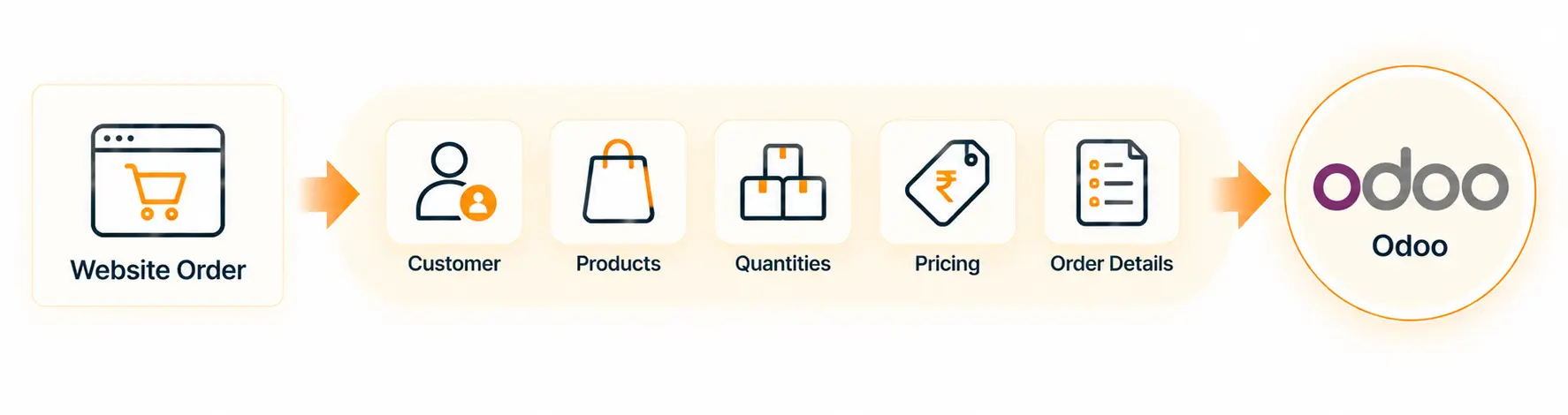
Ecommerce Order → Odoo
Whenever a customer placed an order through the website, the integration automatically transferred the relevant information into Odoo.
This included:
Customer → Products → Quantities → Pricing → Order Details
The corresponding transaction was created in Odoo without requiring an employee to manually recreate the order.
Order Cancellation → Odoo
The integration also handled order cancellations.
When an order was cancelled on the ecommerce platform, the corresponding information was synchronized with Odoo, helping maintain consistency between the two systems.
Odoo Inventory → Ecommerce
Inventory information was synchronized in the opposite direction as well.
When stock was purchased or otherwise updated in Odoo, the corresponding inventory information could be pushed back to the ecommerce platform.
This created a more consistent inventory position across the business.
Bidirectional Synchronization
The core of the solution was the bidirectional integration between ecommerce and Odoo.
Rather than relying on employees to manually move information between systems, the integration automated the movement of relevant data between the two platforms.
The Transformation
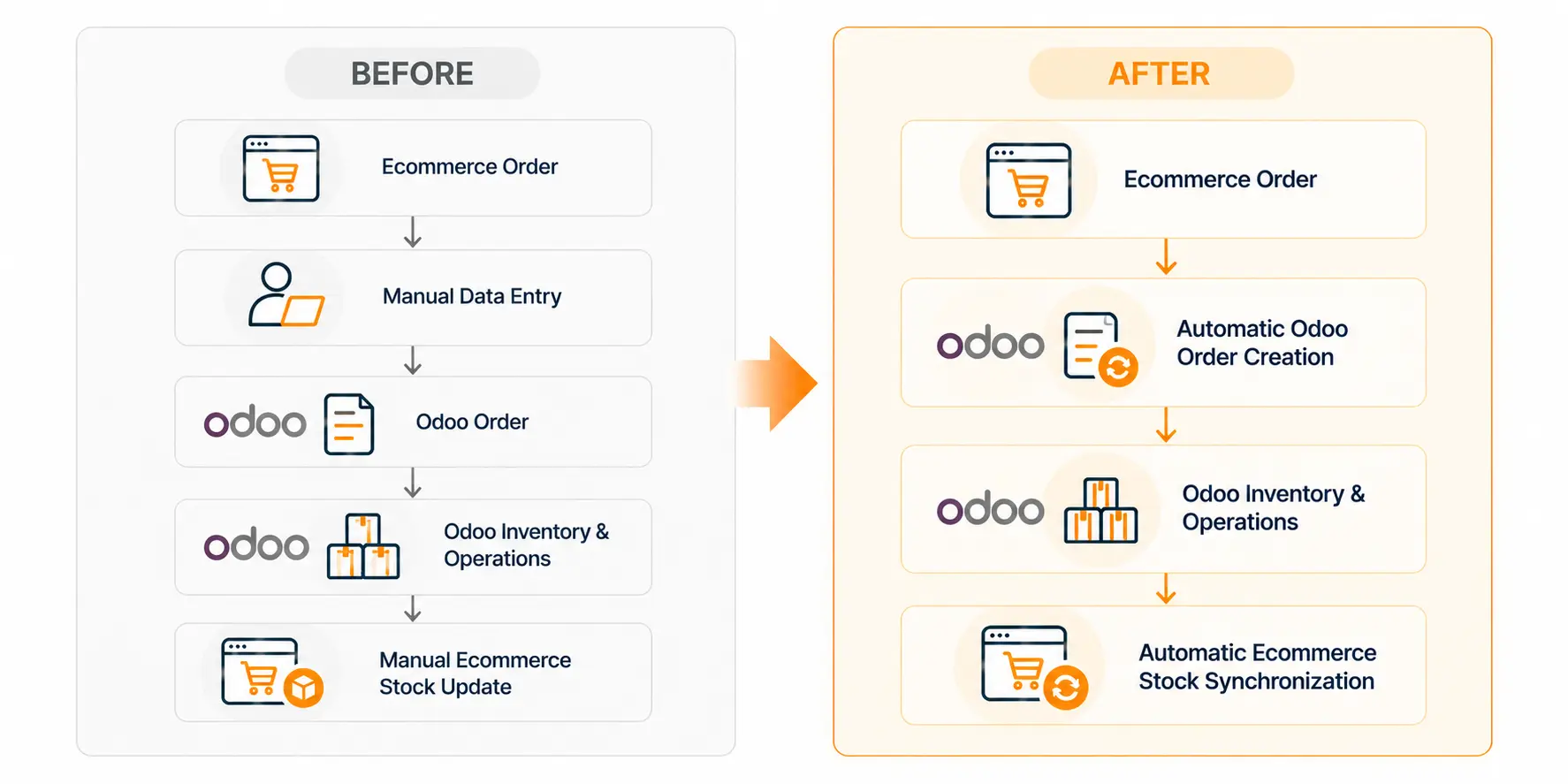
The integration transformed Odoo from a system that employees had to manually update into a connected ERP that could automatically receive and exchange information with the ecommerce operation.
The Impact
The integration significantly reduced the amount of manual work required to process ecommerce transactions.
Reduced Manual Data Entry
Employees no longer needed to recreate every ecommerce order manually in Odoo, freeing them from repetitive administrative work.
Better Inventory Accuracy
Synchronizing inventory between Odoo and the ecommerce platform reduced discrepancies and provided a more consistent view of available stock.
Faster Order Processing
Orders could flow into Odoo automatically, reducing the time between an online purchase and its availability within the ERP workflow.
Lower Operational Dependency
The business could handle its growing ecommerce operations without increasing manpower proportionally for repetitive data-entry tasks.
Fewer Human Errors
By replacing repetitive manual entry with automated data synchronization, the business reduced the risk of errors in order and inventory records.
Conclusion
For an ecommerce business managing thousands of products, the challenge is not simply processing more orders — it is maintaining accurate information across every system as the business grows.
By connecting the client's ecommerce platform with Odoo, Areterix automated critical order and inventory workflows, reduced repetitive manual work, and created a more reliable flow of information between ecommerce and ERP.
The project demonstrates how custom Odoo integrations can connect existing business platforms and automate operational processes without forcing businesses to replace the systems they already rely on.
Odoo Partner in Ahmedabad | Odoo for Ecommerce | Odoo for Manufacturing | Odoo Ecommerce Connector | Odoo 19 | Odoo Partner in India | Odoo ERP | Odoo 20