
Client Profile
Country: India (Hyderabad)
Industry: Distribution & Wholesale, Furniture Distributor, Manufacturing
Apps implemented: Sales, Inventory, Barcode, Manufacturing, Invoicing, Accounting, Whatsapp API
Customer Segment: Retailers and other wholesalers
Products: All type of furnitures and fixtures
ERP: Odoo Community
MNF Entrepreneurs is a furniture manufacturing and distribution business based in Hyderabad, India.
The company primarily operates as a B2B furniture distributor, importing products and components from China and other international markets. Alongside distribution, the company also manufactures selected products locally.
Its operations include:
- 30–40 employees across sales, warehouse, purchase, accounting and operations
- 4 physical warehouses across Hyderabad
- 1 Head Office
- ~500 core SKUs
- ~2,200 products including variants
- 1,000+ orders per month
Before Odoo, the company was using Miracle, primarily as an accounting and invoicing system.
The Challenge
The accounting system could not provide operational inventory visibility
Miracle was being used to manage invoicing, sales and accounting. However, the system was not designed to manage the company's increasingly complex warehouse and distribution operations.
One of the biggest problems was the timing of inventory deduction.
When a sales invoice was generated, inventory was immediately deducted in the system—even if the material had not yet physically left the warehouse.
For example, if an order was invoiced today but scheduled for dispatch tomorrow, the system could already show the stock as unavailable.
This created a significant gap between:
System Stock ≠ Physical Stock
The business needed a system that could distinguish between:
- Ordered
- Reserved
- Ready to Dispatch
- Physically Picked
- Dispatched
- Delivered
They also needed a consolidated view of inventory across four different warehouses.
Orders were coming from multiple channels
The 11-member sales team received orders through different channels, including field sales, WhatsApp, email and Excel.
This created fragmented order management and made it difficult to maintain a consistent process.
A typical order could contain 9–10 line items, while some orders had 20–25+ products.
Since products were distributed across multiple warehouses, sales teams also had difficulty determining:
"Which warehouse has which products, and from where should this order be fulfilled?"
Warehouse operations were largely manual
The company needed better control over:
- Rack locations
- Putaway
- Picking
- Product identification
- Lot/serial tracking
- Box-level movement
- Barcode scanning
The existing process did not provide warehouse teams with a guided workflow for locating and picking products.
Accounting reconciliation was highly manual
The company processed a large number of vendor invoices and payments.
For example, a vendor could have 40–50 invoices outstanding, totaling ₹20 lakh. If the company subsequently made an ₹8 lakh payment, the accounting team had to manually identify and reconcile the appropriate invoices.
This created unnecessary accounting effort and made reconciled reporting more difficult.
The Solution
Areterix implemented Odoo 19 as a centralized ERP covering sales, inventory, purchase, manufacturing, warehouse operations and accounting.
The implementation replaced the fragmented accounting-centric workflow with an integrated operational system.
Centralized Sales & Dynamic Warehouse Allocation
The 11-member sales team was provided with a single interface to capture customer orders directly in Odoo.
Instead of managing orders across WhatsApp, Excel and the accounting system, salespeople could create and manage orders from one centralized platform.
This created a common process from:
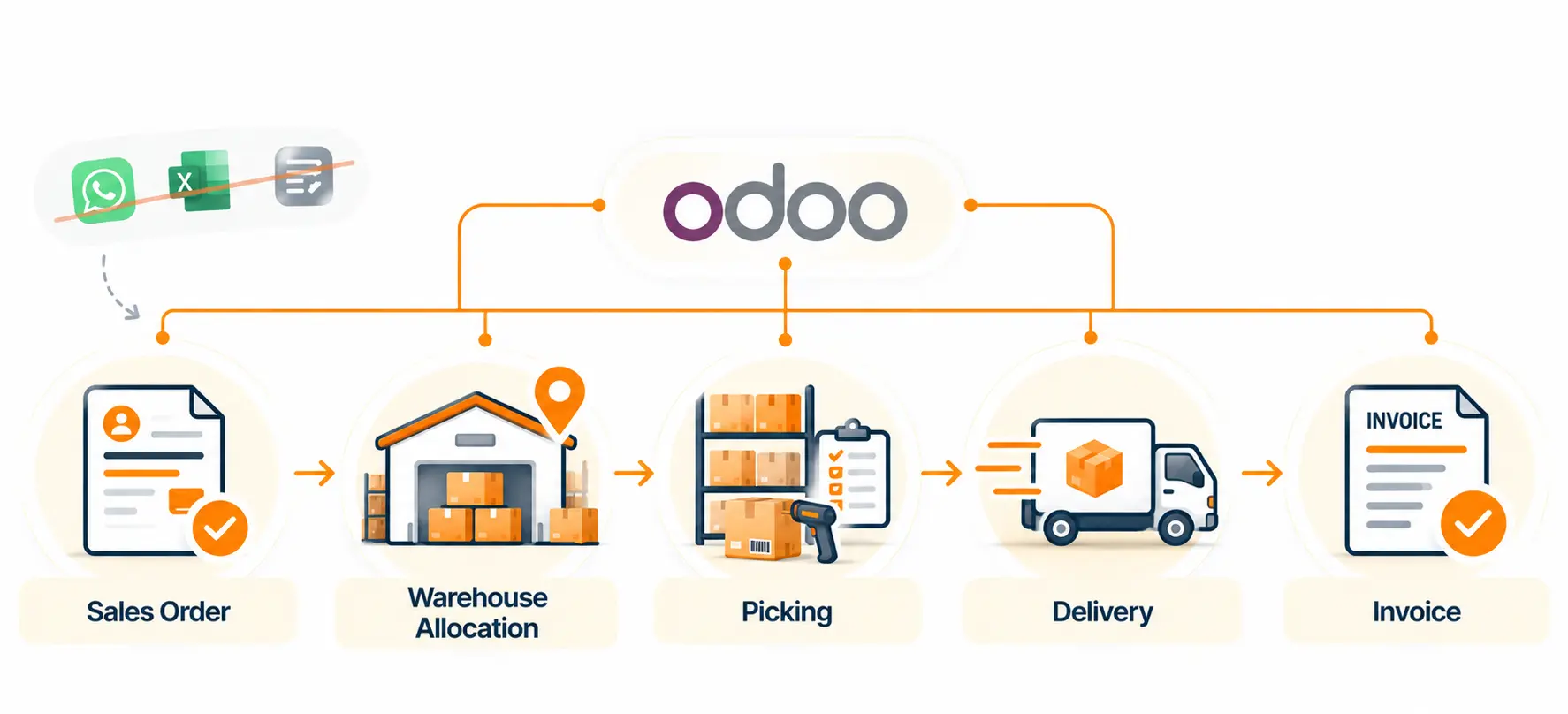
Dynamic Multi-Warehouse Allocation
One of the key customizations was a dynamic warehouse selection workflow.
A sales order could contain products distributed across multiple warehouses.
For example:
| Product | Available Warehouse |
| Product A | Warehouse 1 |
| Product B | Warehouse 2 |
| Product C | Warehouse 3 |
| Product D | Warehouse 1 |
Instead of manually checking inventory warehouse by warehouse, the sales team could select the required warehouses after entering the order.
The system would determine where the required products were available and generate the appropriate delivery operations for each warehouse.
This gave both sales and warehouse teams a global view of inventory availability across all four warehouses.
Historical Customer Pricing
Because MNF Entrepreneurs operates primarily in the B2B market, historical customer pricing was important.
The same product could be sold at different prices depending on:
- Customer
- Previous order
- Quantity
- Volume discount
- Commercial agreement
Areterix implemented a price history view directly against sales order lines.
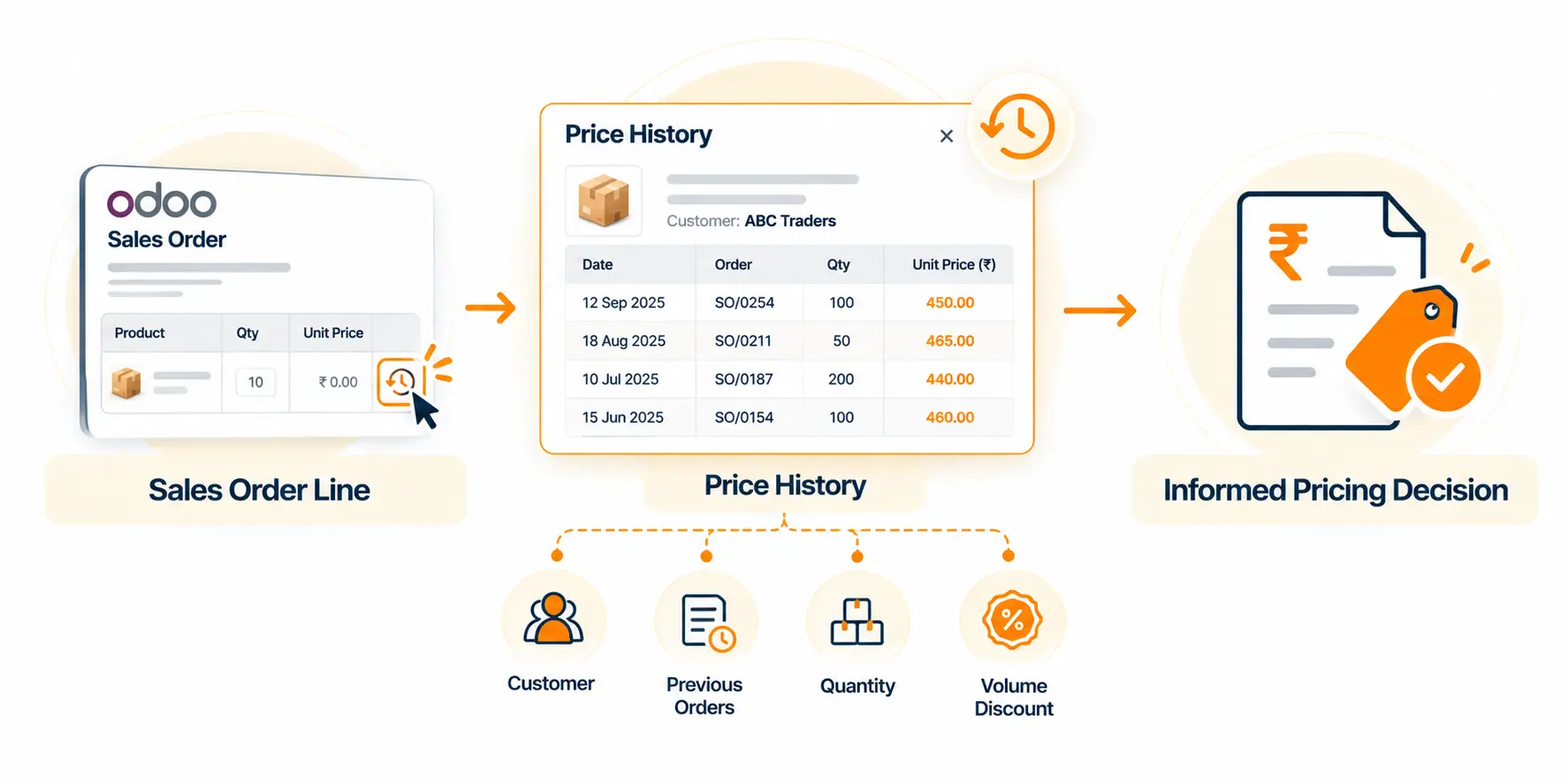
When creating a new order, the sales user could review previous prices offered to that customer and use the historical information to make the current pricing decision.
This reduced the need to search through previous invoices and orders manually.
Warehouse Management & Barcode Operations
In the second phase, Areterix implemented structured warehouse and barcode operations across all four warehouses.
Rack & Location Management
Each warehouse was structured into defined locations and racks.
Every rack was assigned a location ID, allowing Odoo to track where materials were physically stored.
Putaway rules were configured so the system could determine:
Which product should go to which warehouse and which rack?
When purchased material arrived, warehouse users could follow the system-defined putaway process rather than relying purely on manual knowledge.
Barcode-Based Picking
Barcode operations were implemented using Android-based scanning devices.
The process covered:
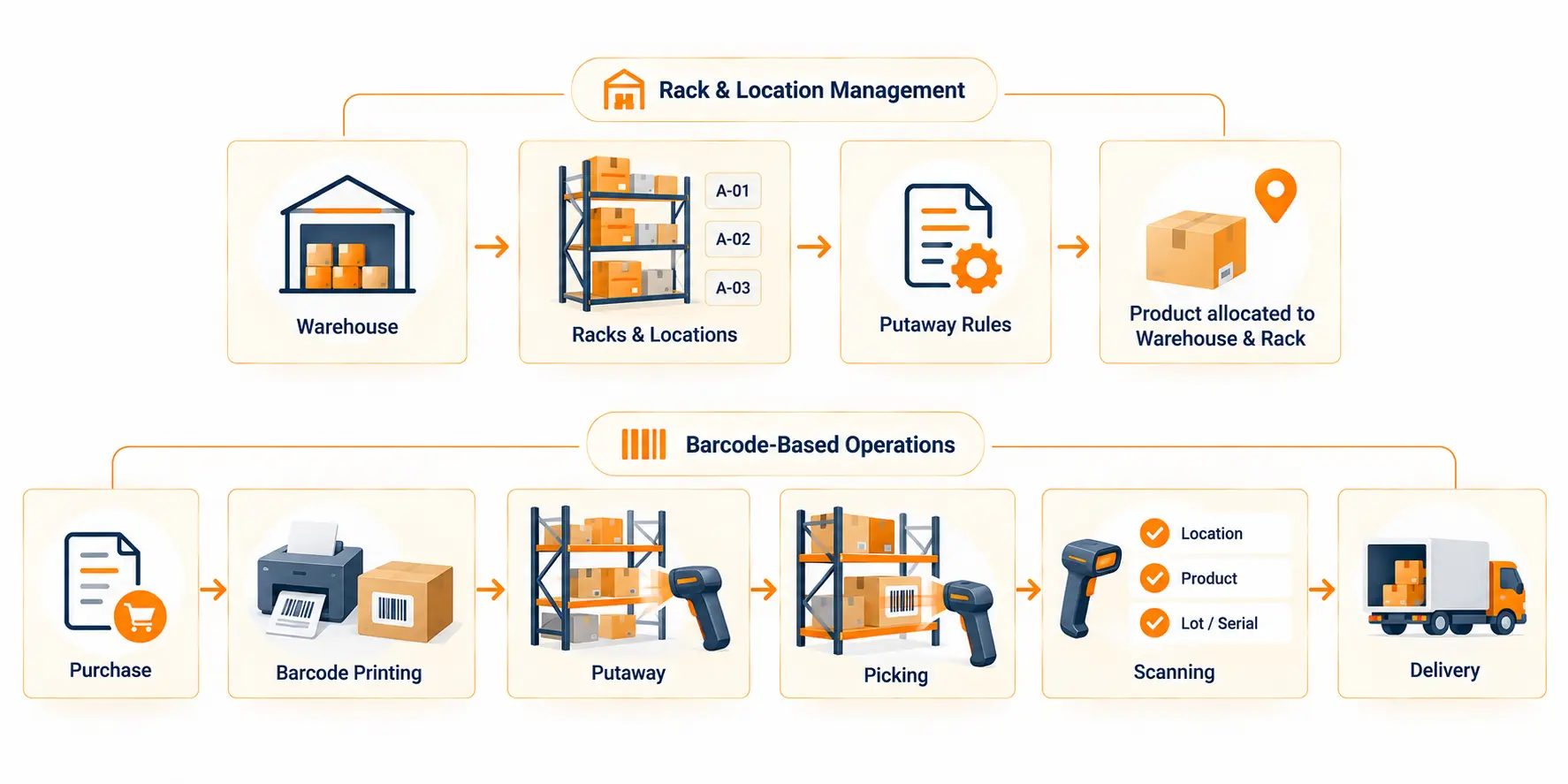
Product barcodes could be generated and printed from Odoo before the products were stored.
During picking, warehouse operators could scan:
- The warehouse location
- The product
- The relevant lot/serial information where applicable
The system guided the picker through the required picking operation.
Multiple Product Tracking Methods
The warehouse workflow was customized to support different product configurations.
Product-level tracking
For products sold individually, the picker scans the individual product.
Lot-level tracking
For lot-tracked products, the picker scans the product and then the relevant lot.
The selected lot is added to the picking operation.
Box-level movement
For products that move as complete boxes, the box itself carries a barcode.
Instead of scanning every individual unit, the warehouse operator can scan the box barcode and move the complete box as one operational unit.
This allowed the barcode workflow to reflect the company's actual warehouse processes instead of forcing every product into the same scanning model.
Basic Manufacturing Operations
Although distribution is the company's primary business, MNF Entrepreneurs also manufactures selected products locally.
Odoo Manufacturing was implemented for the company's basic production process.
The workflow includes:
Bill of Materials → Manufacturing Order → Raw Material Consumption → Production → Finished Goods
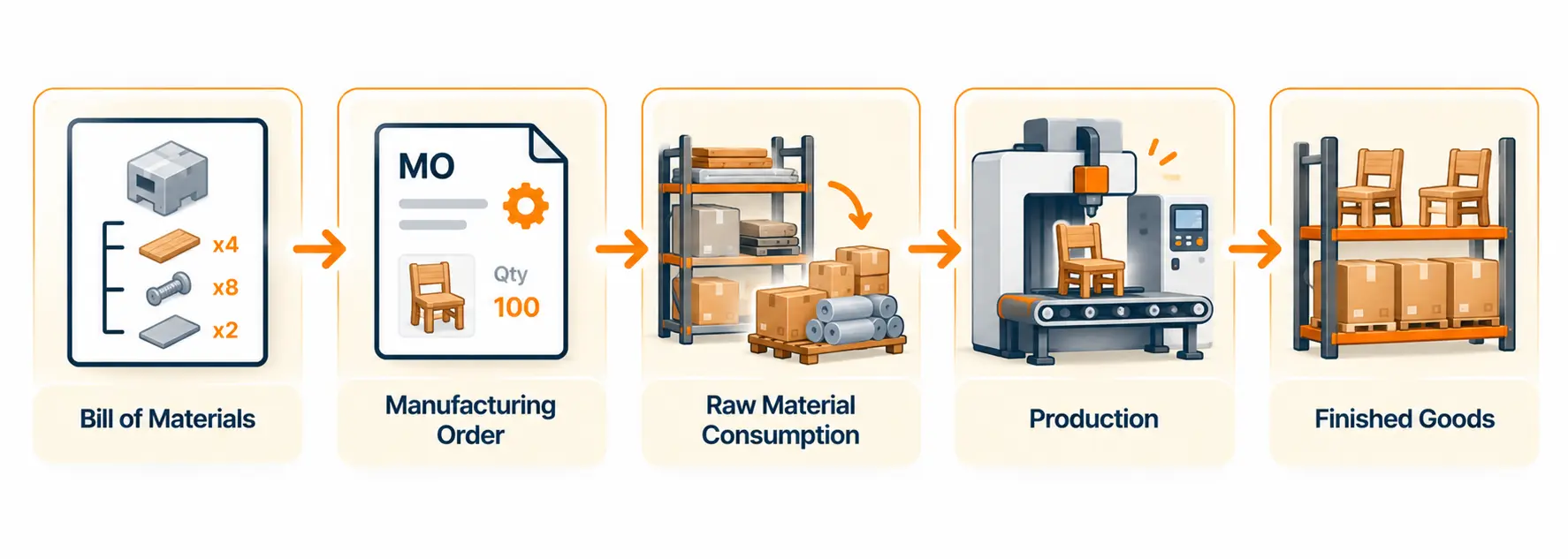
The team can create a Bill of Materials for a product and generate a Manufacturing Order based on the required production quantity.
Raw materials are consumed during production and finished goods are added back into inventory.
Import Order Tracking
Since a significant portion of the company's products are imported from China and other international markets, Areterix implemented additional tracking around international purchase orders.
The company can track important milestones such as:
- Purchase order date
- Supplier production start
- Supplier dispatch date
- Expected delivery
- Arrival at Indian port
This gives the purchase team greater visibility into the status of international orders and allows them to compare actual progress against supplier commitments.
WhatsApp Invoice Communication
WhatsApp communication was integrated into the invoicing workflow.
Once an invoice was generated, users could send it directly through WhatsApp from the system.
Multiple WhatsApp templates were configured for different communication requirements, reducing the need to manually download invoices and share them separately.
Integrated Accounting
The implementation also covered the company's complete accounting operations.
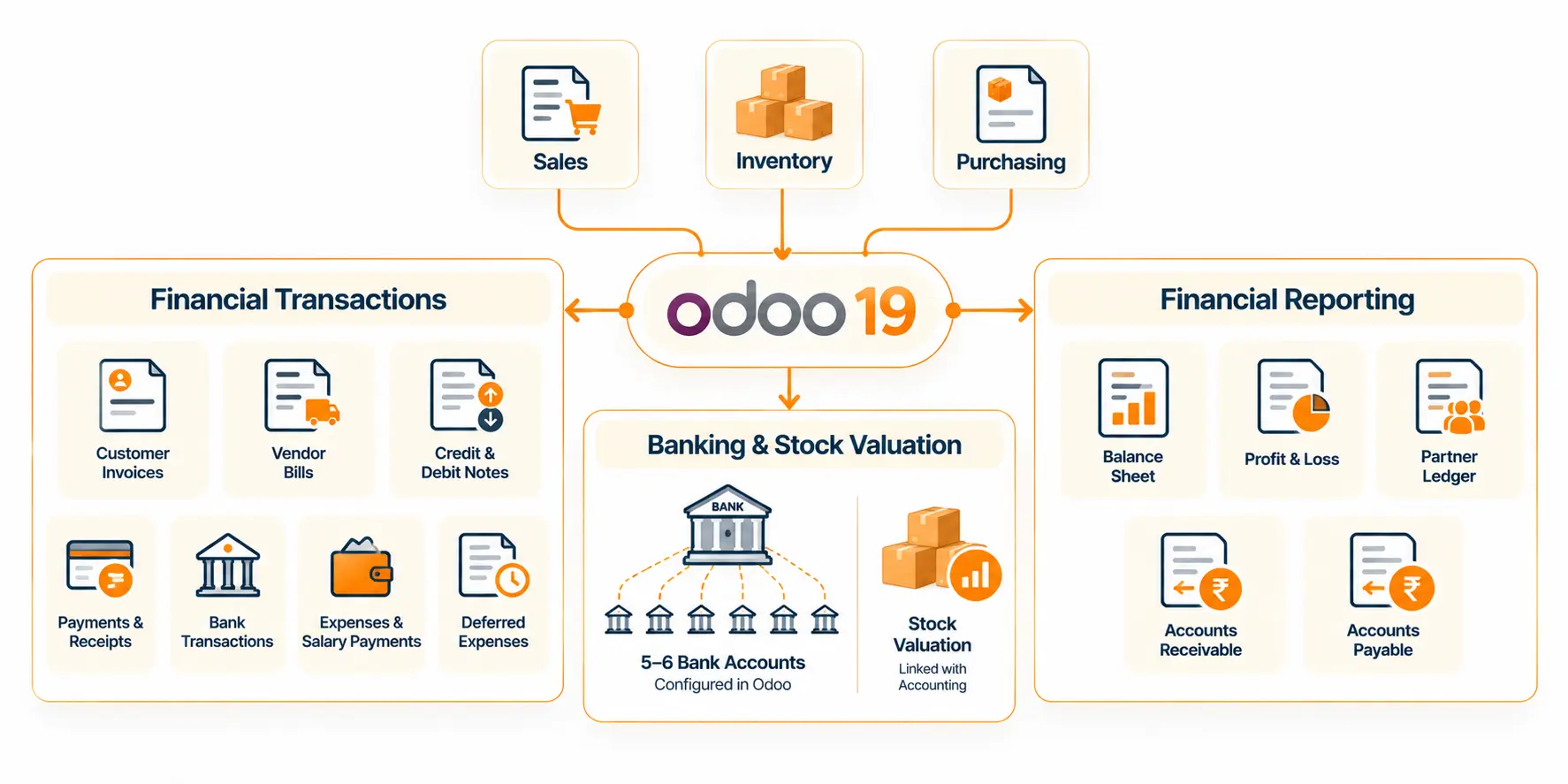
The company had multiple bank accounts, with approximately 5–6 accounts configured within Odoo.
This allowed financial transactions to be managed within the same system as sales, inventory and purchasing.
The Transformation
MNF Entrepreneurs moved from an accounting-focused system where inventory and operational processes were largely disconnected to a centralized ERP covering the complete business workflow.
Before Odoo
Sales
- Orders managed across multiple channels
- Limited centralized visibility
- Manual price history checking
Inventory
- Inventory deducted at invoicing
- Limited real-time warehouse visibility
- Four warehouses managed with limited centralized control
Warehouse
- Manual rack and picking processes
- Limited barcode-driven operations
Accounting
- Significant manual reconciliation
- Accounting separated from operational workflows
After Odoo 19
Sales → Inventory → Warehouse → Delivery → Invoicing → Accounting
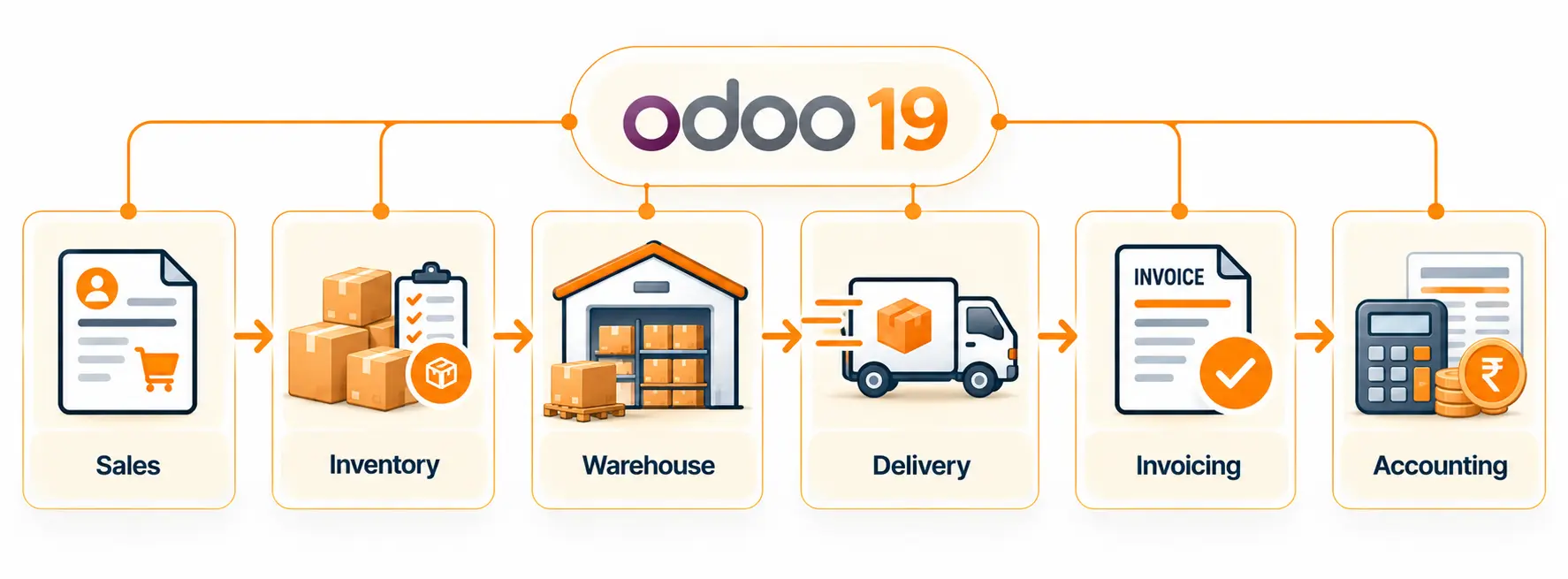
The company now operates on a single system where sales orders, inventory availability, warehouse fulfillment, manufacturing and accounting are connected.
Key Takeaway
The transformation gave MNF Entrepreneurs operational control over a multi-warehouse distribution business.
Odoo 19 became the central platform connecting sales, inventory, warehouse operations, manufacturing, purchasing and accounting, while custom workflows addressed the company's specific requirements around multi-warehouse fulfillment, pricing, barcode operations, import tracking and financial reconciliation.
Odoo for Distribution Business | Odoo 20 | Odoo for furniture business | Odoo for wholesalers | ERP for Distribution business | ERP for wholesalers | ERP for Distributors | Odoo 19 | Odoo for Distributors | Furniture wholesalers | Odoo in Qatar | Odoo in Oman | Odoo ERP