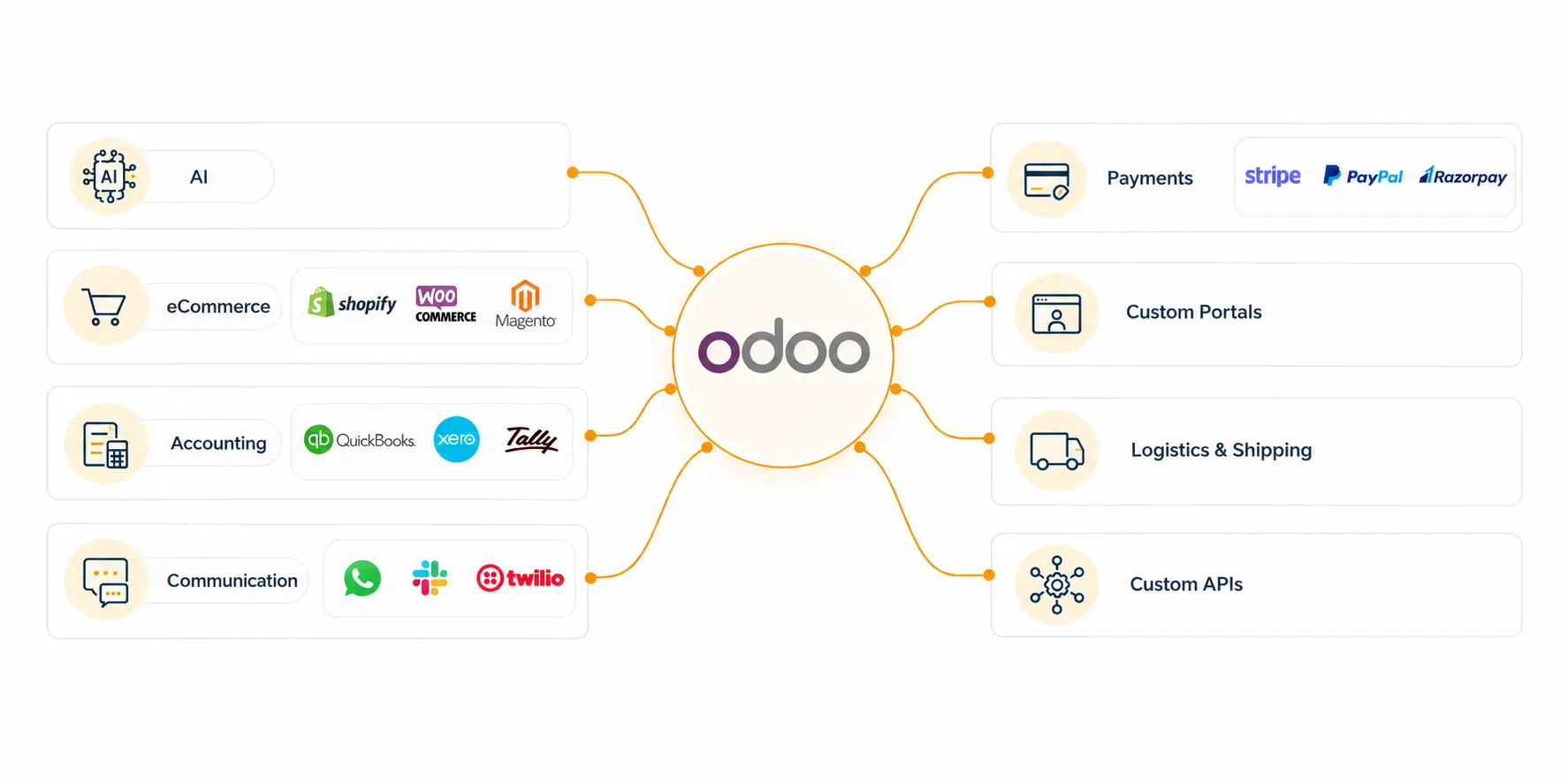
What you get?
Integration Scoping & Data Mapping
We start by understanding how your systems exchange information. Our Odoo integration team maps the data flow, defines the system of record for each data object, and determines the right synchronization approach — real-time, scheduled, or hybrid.
Two-Way Data Synchronization
Depending on your requirements, we will integrate customers, sales orders, invoices, payments, inventory, products, and other business data in both directions, with clearly defined rules for handling conflicts and duplicate records.
Secure API Authentication
We implement secure authentication methods such as OAuth and API keys while keeping credentials separated across development, staging, and production environments. Sensitive credentials are securely managed rather than embedded directly into application code.
Data Reconciliation & Sync Monitoring
Automated reconciliation helps identify differences between Odoo and connected systems. Scheduled reports can highlight missing, duplicated, or inconsistent records so your team can quickly identify and resolve synchronization issues.
Error Handling & Automatic Retries
Our integrations are designed to handle common API failures such as timeouts, temporary service interruptions, and rate limits. Recoverable errors can be retried automatically, while permanent failures are captured with enough context for your team to investigate and resolve them.
Monitoring & Alerts
We provide visibility into integration activity through structured logs and monitoring of synchronization volume, failures, and processing delays. Where required, alerts can notify your team when an integration requires attention.
Webhook & Real-Time Integrations
For systems that support webhooks, we can build real-time event handling between Odoo and third-party platforms. Webhook processing can include signature verification, duplicate-event protection, idempotent processing, and controlled event replay.
Integration Documentation & Handover
Every integration should be understandable after development is complete. We document the integration architecture, data flows, API dependencies, synchronization rules, error-handling process, and common troubleshooting steps so your team can confidently manage the system in production.
Our Integration Plan
A structured approach to connecting Odoo with eCommerce platforms, marketplaces, third-party applications, and external business systems.

Integration audit
We begin by reviewing the systems that need to connect with Odoo and understanding how data currently moves between them. We identify manual processes, existing connectors, API limitations, data dependencies, and the required synchronization points.
3-5 Days

Architecture & quote
We define the integration architecture before development begins. This includes data mapping, synchronization direction, frequency, conflict-handling rules, authentication requirements, error handling, and the overall integration workflow.
You receive a clearly defined scope and effort estimate for each integration.
1 week

Build
Our Odoo developers build and configure the integration according to the approved architecture. Depending on the requirement, this can include API integrations, webhooks, scheduled synchronization, two-way data exchange, custom Odoo modules, and automated error handling.
Each integration is developed with monitoring, retries, and reconciliation in mind from the beginning.
2-4 weeks per integration

Staging validation
Before going live, the integration is tested against real-world scenarios in a controlled environment. We validate data mapping, synchronization accuracy, duplicate handling, failed transactions, and edge cases.
Reconciliation checks help identify differences between Odoo and the connected system before production rollout.
2 weeks

Production Rollout
Once validation is complete, the integration is deployed to production in a controlled manner. Where appropriate, we use a phased rollout so the integration can be monitored closely before full-scale deployment.
We verify data synchronization, transaction processing, error handling, and system performance during the rollout.
1 - 2 Weeks

30-day stabilization
The first few weeks after launch are important for identifying real-world scenarios that may not appear during testing. We monitor synchronization, review reconciliation results, and resolve issues discovered during the stabilization period.
Any new functionality or changes outside the agreed scope can be assessed and quoted separately.
30 Days
Typical Timeline
Most Odoo integrations take approximately 2–4 weeks to develop, depending on the systems involved and the complexity of the data exchange.
Simple integrations with well-documented APIs can often be completed toward the shorter end of this range. More complex integrations involving two-way synchronization, large data volumes, custom business rules, or multiple systems may require additional time.
For projects involving multiple integrations, development can be carried out sequentially or in parallel depending on the project scope and dependencies.
What affects the price
Every engagement is fixed scope after the initial integration audit. These are the levers that move a quote up or down.
Number of Integrations Connecting Odoo with one platform is different from connecting Odoo with Shopify, Amazon, WooCommerce, payment gateways, and other systems. Each integration has its own development, testing, and deployment requirements.
|
One-Way vs. Two-Way Sync A one-way integration is generally simpler than a two-way synchronization. When data needs to move in both directions, additional rules are required for updates, duplicates, and conflicts between systems.
|
API & Technical Complexity Modern APIs with clear documentation are generally faster to integrate. Older APIs, limited third-party systems, custom databases, or systems without standard APIs may require additional development and testing.
|
Data Volume & Sync Frequency The amount and frequency of data also affect the integration architecture. Real-time synchronization and high-volume data transfers may require additional processing, queuing, batching, and monitoring.
|
Who is this for?
Our Odoo integration services are designed for businesses that need Odoo to exchange data with other business systems.
Common use cases include:
- eCommerce: Connect Shopify or WooCommerce with Odoo for orders, products, inventory, customers, and fulfillment.
- Marketplaces: Integrate Amazon and other marketplaces with Odoo for centralized order and inventory management.
- Payments: Connect payment platforms with Odoo to automate transaction and payment reconciliation.
- CRM: Synchronize leads, customers, opportunities, and sales data between Odoo and CRM platforms.
- Accounting & Finance: Connect Odoo with accounting or financial systems to reduce manual data entry.
- Manufacturing: Exchange production, inventory, or operational data between Odoo and external manufacturing systems.
- Custom Business Systems: Connect Odoo with proprietary software, supplier platforms, databases, or other third-party applications.
Whether you are implementing Odoo for the first time or extending an existing Odoo system, we can design the integration around your business workflow and the systems you already use.
FAQ
Both, depending on the integration. Real-time (webhook-driven) for events that need immediate consistency — payments, order status. Batched (every 5–60 minutes) for high-volume objects where eventual consistency is fine — inventory, customer attributes. We pick the strategy per integration during scoping.
Transient failures (rate limits, timeouts) retry automatically with exponential backoff. Permanent failures route to a triage queue with structured context — affected records, error message, timestamp, retry count. Most teams configure Slack/PagerDuty alerts so issues surface within minutes.
Yes — we use Odoo's recommended integration patterns (deferred jobs, REST endpoints, OWL widgets) specifically so they survive major-version upgrades. We test integrations against the Odoo CI image before each major version release.
We audit them before quoting changes. Many partner-built integrations have no reconciliation, no error handling, and no observability — fixing those is often quicker than rebuilding from scratch. We share the audit before any work so you can decide.
Yes — backfill of historical data is a standard part of integration scoping. Backfills run as separate idempotent jobs that you can re-run as many times as you need against staging before flipping the switch in production.
Yes for systems your team owns (your Stripe account, your Shopify store, your Salesforce instance). For systems owned by partners, we work with their team — but the engagement still completes against an agreed scope, not 'when their team eventually configures their side'.
We offer a 30-day return policy for all products. Items must be in their original condition, unused, and include the receipt or proof of purchase. Refunds are processed within 5-7 business days of receiving the returned item.