What you get?
Paid one-week discovery
Process mapping, current-system audit, gap analysis, and a written diagnostic. Output usable on its own even if you don't proceed.
Blueprint
Module map, integration list, custom-development scope, data-migration plan, training plan, and a written quote.
Module configuration
All standard Odoo modules configured to your business processes — Sales, Purchase, Inventory, Manufacturing, Accounting, HR, Project, and CRM as scoped.
Custom modules and workflows
Python-based custom development for behavior the standard modules don't cover, written to upgrade-safe patterns.
Data migration
Master-data and transactional-data migration from your current system, including parallel-run reconciliation and a clean cutover.
Integrations
Two-way connectors to your CRM, payment gateway, shipping carriers, e-commerce, and any vertical SaaS your team relies on.
Role-based training
On-site or remote training for end users, super-admins, and finance/operations leadership. Recorded sessions and a playbook for ongoing onboarding.
90-day hypercare
Dedicated post-launch support team for 90 days, with a clean handoff to retainer or on-demand support.
Our Process

Discovery
One-week deep dive into your current ERP, processes, and target outcomes. Output: a written diagnostic with module map and risk register.
1-2 weeks

Blueprint
Fixed-scope quote, module configuration spec, custom-dev list, integration plan, data-migration approach, and training plan — all signed off before build.
1 week

Build
Iterative two-week sprints with weekly demos. Your team gets UAT environment access from week one for hands-on review and feedback.
8-14 weeks
User acceptance testing
Real-data UAT with end users running their actual workflows. Sign-off checklist, bug triage, and role-specific training before cutover.
2 weeks

Go-live
Cutover weekend with a documented and rehearsed rollback plan. 72 hours of on-call hypercare coverage immediately after go-live.
1 weekend

Hypercare and handoff
90 days of dedicated post-launch support with a named team, then transition to a retainer or on-demand engagement of your choice.
90 Days
Typical Timeline
For most growing, departmental businesses, an Odoo implementation typically takes 10–16 weeks from discovery to go-live. Simpler implementations with fewer departments and clean data can be completed in 6–10 weeks, while complex implementations involving multiple departments, customizations, integrations or extensive data migration may take 16–24+ weeks, phased by business unit.
The timeline depends on the number of departments, modules, customizations, integrations, data quality and user readiness. During the blueprint stage, we create a clear implementation schedule so you know what happens at each stage, what we need from your team, and when your business can expect to go live.
What affects the price
Every engagement is fixed-scope after a paid one-week discovery. These are the levers that move a quote up or down.
Number of modules Each module adds configuration time. A 3-module starter (Sales + Inventory + Accounting) is faster to scope than a 12-module ERP-wide rollout.
|
Custom-development scope Standard Odoo handles ~80% of common requirements out of the box. The remaining 20% — custom workflows, vertical-specific reports, unusual approval chains — drives most of the variable cost.
|
Integrations Each connector to a third-party system (CRM, e-commerce, payment, shipping, vertical SaaS) is roughly 1–3 weeks of work depending on complexity and the third party's API quality.
|
Data-migration complexity Migrating from a clean modern system is fast. Migrating from a legacy ERP with inconsistent data, custom fields, or no API costs more — usually 2–4 weeks of additional cleanup.
|
Number of countries / entities Multi-country rollouts add localization (tax, e-invoicing, statutory reports) and consolidated reporting. Each additional entity adds 1–2 weeks.
|
Training depth Standard role-based training is included. Train-the-trainer programs, recorded course libraries, and ongoing onboarding kits are scoped separately. |
Who is this for?
Growing SMEs whose business has become more complex as departments, people, products and processes have grown.
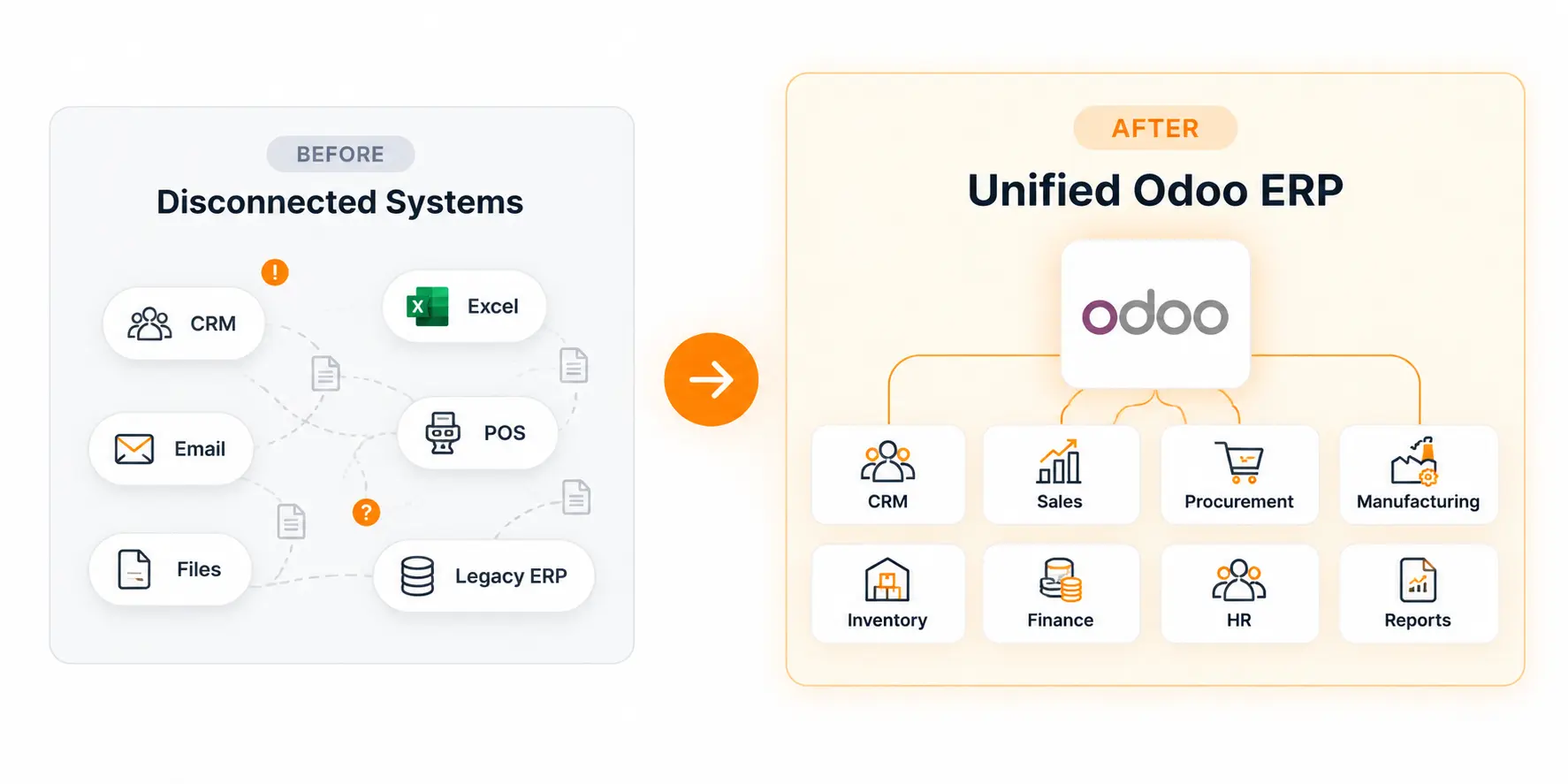
You have outgrown spreadsheets, Tally, QuickBooks, a legacy ERP or multiple disconnected systems and now looking to bring Sales, Purchase, Inventory, Manufacturing, Accounting and other departments onto one integrated platform.
Our approach is best suited for businesses that want an experienced partner to understand their processes, implement Odoo around their business, and support their teams through the transition.
If your current systems are making it difficult to get real-time visibility, reduce duplicate work, maintain traceability or make confident business decisions, Odoo may be the right next step.